FOOD
The Black Diamond of Provence
By Monica D. Royce
June 2026
Tuber melanosporum — the Périgord black truffle — reaches its greatest concentration in the oak forests of the Vaucluse, where a winter ritual of extraordinary intensity unfolds.
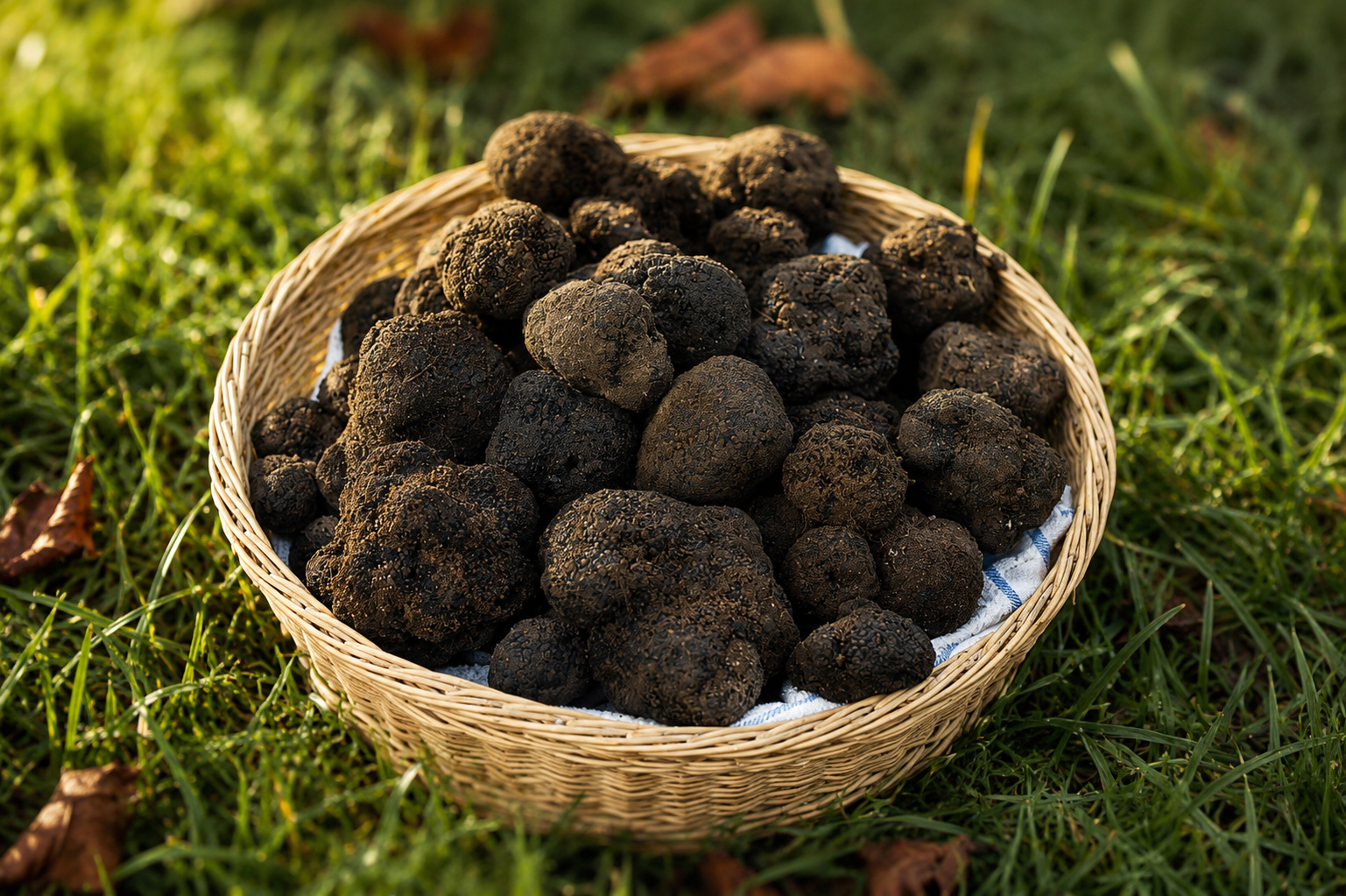
Harvested beneath oak trees during the winter months, black truffles remain one of Provence's most distinctive culinary traditions.
PHOTO - NOTES EDITIONS
In the oak forests of the Vaucluse, on winter mornings when the frost has not yet lifted from the ground and the light is still low and lateral, a man and his dog move slowly between the trees. The dog — a Lagotto Romagnolo, or perhaps a trained mongrel, the breed matters less than the nose — moves in widening circles, head down, reading the soil. Then it stops. Scratches. The man kneels, brushes aside a thin layer of earth, and there — dark, rough-surfaced, smelling of something between damp forest floor and concentrated earth and something else, something deeper, something that has no name in English — is a truffle. Tuber melanosporum. The black diamond of Provence.
The truffle is, botanically, the fruiting body of a subterranean fungus that grows in a symbiotic relationship with the roots of certain oak trees — principally the downy oak, Quercus pubescens — on the alkaline, well-drained soils of the limestone plateaux of the Vaucluse and the Drôme Provençale. It cannot be cultivated in the conventional sense; the relationship between fungus and oak is too complex, too dependent on specific soil chemistry and microclimate, too indifferent to human scheduling. Truffières — truffle orchards, planted with inoculated oaks on prepared ground — can produce results after seven to ten years, and there are several thousand hectares of them across Provence, but the finest truffles still come from wild-harvested ground, and the finest of those still come from the Apt Basin and the hills around Carpentras and Valréas.
Richerenches: The Cathedral of Truffles
On Saturday mornings between November and March, the village of Richerenches — a small, walled town on the Tricastin plateau north of Orange — hosts what is claimed to be the largest truffle market in Europe. It does not look like a market. There are no stalls, no displays, no prices written on boards. Buyers and sellers meet in the street — the Avenue de la Rabasse, rabasse being the Provençal word for truffle — and transactions happen in murmured conversations, hands moving in coat pockets, figures whispered, deals made and unmade in a matter of seconds. The smell, on a good morning, is overwhelming: that concentrated, dark, animal-vegetable perfume that you either find immediately compelling or do not understand at all.
Prices fluctuate with the harvest. A poor year — too dry in summer, too warm in autumn — can push prices above €1,000 per kilogram for top-quality truffles. A good year brings them down to €500–700. Either way, the transaction at Richerenches is conducted with the seriousness of a commodity exchange, because that is, in effect, what it is. Restaurants, dealers, private buyers, and the occasional tourist who has done their research all converge on this unremarkable village street on Saturday mornings, and for a few hours between nine and noon the Tricastin plateau becomes the centre of one of France's most specialised and closely guarded food trades.
In the third week of January, Richerenches holds the Messe de la Truffe — the Truffle Mass — in which the congregation, by tradition, pays its offering to the church in truffles rather than money. The priest accepts them. The village accepts this as entirely normal. It is one of the more purely Provençal things that happens in Provence.
The Flavour: What a Truffle Actually Tastes Like
The Périgord black truffle has a flavour that is genuinely difficult to describe to someone who has not encountered it, because it does not resemble any other flavour. It is earthy, but not in the way that mushrooms are earthy — it is deeper, more complex, with a kind of musky animal quality that some people find immediately compelling and others find alarming. It is also intensely aromatic, and the aroma does much of the work: a dish made with black truffle smells, quite distinctly, of truffle before it tastes of anything at all. The flavour is concentrated and persistent; a small amount does a great deal.
The Périgord black truffle, one of Provence's most celebrated seasonal ingredients.
PHOTO - NOTES EDITIONS
The classic Provençal preparations respect this. A truffle omelette — eggs beaten with truffle shavings left to perfume them overnight in a sealed jar, cooked in butter until just set — is the purest expression of what the ingredient can do. Pasta with truffle and a little butter. Risotto finished with truffle and Parmesan. Roast chicken with truffle slipped under the skin twenty-four hours before cooking. These are not complex preparations, and that is the point: the truffle does not benefit from competition.
Where to Experience Truffles in Provence
Beyond Richerenches, the truffle culture of Provence is most concentrated in the Apt Basin — the broad valley around Apt, Bonnieux, and Ménerbes — and in the hills around Carpentras and Vaison-la-Romaine. The village of Aups, in the Var, holds a well-regarded truffle market on Thursday mornings in winter. Périgord, the restaurant in the village of Murs, is run by a truffle producer and serves a menu almost entirely built around the ingredient in season. For a truffle hunt with a guide and dog, several operators around Carpentras and Apt offer morning excursions between November and March; the experience of watching a trained dog work the ground and finding a truffle yourself is one of those Provençal pleasures that no amount of description adequately prepares you for.